








![]() |
|||||||||||||||||||||||
![]() |
One theory about Roman society and its preference for highly flavoured foods is that lead poisoning was prevalent among the aristocracy, due mainly to the use of lead lined pots used for boiling a preservative syrup required by wine merchants. As the symptoms of this complaint include a metallic taste in the mouth and loss of appetite, it would follow that a chronic sufferer would seek to kill this unpleasant taste and stimulate his jaded appetite. The final collapse of a great empire had a strange connection with one of the most highly prized spices of the time. The barbarians who gathered at the gates of Rome in the fifth century A.D. demanded, amongst other tributes of land, subsidies and military titles, no less than three thousand pounds of pepper.
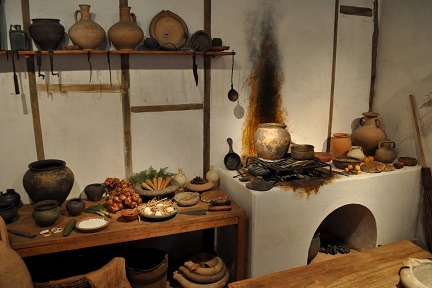
Food and cooking are timeless and universal. The Babylonians used the same basic equipment to be found in their modern equivalents today. Colanders and saucepans, strainers and skillets were used in Pompeii and pastry cutters were part of cooking equipment in Gaul in 200 A.D. From excavations in Britain we can deduce that the daily business of preparing and serving food has always been one of the main social activities of mankind. Although the twentieth century housewife would not have found the Roman kitchen 'labour-saving', (but with that we must remember that neither has she the substitute number of slaves), she would nevertheless be able to use many Roman ingredients and utensils with little noticeable difference. A typical kitchen in Roman Britain in about 200 A.D. would have looked very similar to that shown below. The most recognizable feature is the raised hearth, a masonry construction of table height, on which was placed the charcoal, and over this most of the cooking was done, in vessels supported by iron tripods or grid irons. A fine example of a grid iron from Silchester has been copied in this reconstruction. Wood was also used, as some recipes refers to certain dishes being smoked. Arrangements for providing water for cooking and washing up are sometimes found, and stone or wooden tables for food preparation. ![]()
Portable ovens made of earthenware, iron, bronze or occasionally of more precious metals have been found. These presumably for cooking smaller items, such as leeks rolled in cabbage leaves, or pastry dishes. Ornamental water heaters for keeping dishes warm, or cooking by the 'double saucepan' method have also been found. Cauldron chains such as the example displayed in the Corinium Museum were used for suspending large cooking pots over a wood fire. Large animals such as boar or venison were roasted on spits.
A variety of kitchen equipment was available to the serious cook. The frying pan or fretale, made of bronze, round or oval in shape, with a lip for pouring, is well known, as are rectangular iron trays with handles for roasting or frying. 'Oven to table ware' in the form of shallow pans and earthenware dishes was common. These are referred to as patellae and patinae. The difficulty in cleaning these utensils is understandable. Metal ware could be cleaned with sand, but earthenware dishes and pots would soon become unfit for use and would need constant replacement which could account for the considerable quantity of broken items revealed by excavations. Fortunately local potteries would have been able to turn out cheap dishes for ordinary use. Knives of all sizes were used, made of iron, with bone, wood or bronze handles. Spoons of bronze, silver and bone have also been discovered. Ladles, dippers, strainers and choppers all found a place in the Roman kitchen. Mortaria were stout pottery bowls used for grinding and pounding, made with a sprinkling of grit baked into the clay to form a rough surface. Stone or wooden pestles were used with them.
The daily diet varied considerably between rich and poor. The latter would have had little variation in their daily food beyond course bread and bean or pea broth, with the occasional meat addition. Life in a villa in Roman Britain would have been secure and pleasant for the wealthy owner and his family. Home ground flour and freshly make bread, home grown vegetables, a well stocked orchard of apples, pear, cherry and plum trees; specially reared pigs, sheep and oxen, together with an abundance of wild fish and game, would have assured the inhabitants a variety of good food. Honey was the main source of sweetening, a preservative for meat and fruit and a common ingredient in many dishes and sauces. Beekeeping was, therefore, an important industry, most farms employing one man known as the apiarus to look after the hives.
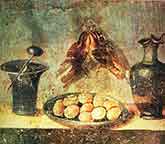
The day would begin with a light breakfast of bread and fruit. Lunch or prandium consisted of a cold meal of eggs, fish and vegetables. Wine and water mixed was drunk with meals, the native beer being considered a barbarian's drink by the sophisticated Roman. The main meal at the end of the day was regarded as an important occasion. The family gathered together, often with friends, after a visit to the public baths or their own private bath suite and sat or reclined in the triclinium, a pleasantly decorated room usually with a fine mosaic floor. This was the room where the Roman host would entertain his guests and seek to display his wealth and status.
Dining was an important social occasion. The Romans enjoyed eating and talking in the formal atmosphere of the triclimium. After, perhaps a pleasant stroll around the garden the guests would assemble ready to to enter the dining room (right foot first over the threshold to avert ill luck) ![]() A Roman dinner party ideally comprised nine guests, in honuour of the nine muses, goddesses of the arts and sciences. Arranged around three sides of a square, the fourth side being left open for serving, the guests would recline on large couches, each accommodating three people. Propping themselves on their left forearms, they would use their right hands for stretching for food and drink. Garlands of rose petals were worn on their heads to ward off the effects of too much wine. Sometimes the guests would pluck rose petals from their garlands and drop them into their wine goblets. With forks being unknown and knives and spoons only occasionally used, most people ate with their fingers - a messy arrangement when sticky sauces were part of the meal. Napkins were provided to protect the couches. Guests would also bring their own napkins, and according to contemporary satirists, sometimes stole their neighbours' napkins. After a suitable offering by the host to the household gods (Lares), the meal would commence.
The main course, or primae mensai varied both in the number and elaboration of dishes. Roast and boiled meat, poultry, game or other meat delicacies would be served. No dish was complete without its highly flavoured and seasoned sauce. Contrary to present day preference, the main object seemed to be to disguise the natural taste of food - possibly to conceal doubtful freshness, possibly to demonstrate the variety of costly spices available to the host. Sometimes so many ingredients were used in a sauce it was impossible to single out any one flavour. One Roman cook bitterly complained that some of his fellow cooks 'When they season their dinners they don't use condiments for seasoning, but screech owls, which eat out the intestines of the guests alive'. Apicius wrote at the end of one of his recipes for a particularly flavoursome sauce, 'No one at table will know what he is eating'. These sauces were usually thickened with wheat flour or crumbled pastry. Honey was often incorporated into a 'sweet-sour' dish or sauce.
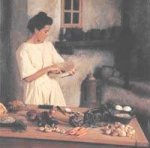
Desserts or mensae secundae, though not considered an important course, would consist of sweetmeats, pastries, dried or fresh fruit and nuts. After the remains of the meal had been cleared away, the guests continued to recline and toast each other with wine, the entertainment continuing in as elaborate a form as the host could afford. Important banquets would often end with clowns or jugglers performing or even gladiator fights. Such a meal would entail a great deal of preparation and we can imagine the scene of frenzied activity in the kitchen beforehand, as cooks and slaves busied themselves under the supervision of the lady of the house. Pots and pans simmered and bubbled over burning charcoal on the stove, ingredients for sauces were pounded and mixed in mortaria, while the cooks made good use of the wine and oil stored in their amphorae, together with herbs and costly spices; all to ensure that the guests would be suitably impressed with their meal. If bread was baked at home, the flour was first ground by hand on a rotary quernstone. Pies and pastries would be put in the oven after the main bread baking was over. Several kinds of flour were used, the fine white variety being considered the best, while dark bread was given to the unimportant visitor. Not everyone cooked at home. Town dwellers would have handy access to the local bakers, pastry cooks and cooked meat shops, as the stone reliefs and excavations of Pompeii illustrate. Oysters, cockles and mussels would be brought from the coast in barrels of brine to be sold inland. Salt was an important commodity, obtained from the many salt pans round the shores of Britain. The native Briton would have seen little change in his diet after the Roman occupation. Most people would have had to exist on meagre and monotonous meals, with flat bread mad from course grain flour, bean pottage or porridge, cooked on an open hearth fire, in cramped conditions, as the normal daily food. Excavations in Cirencester or skeletons from the Roman period have revealed evidence of dental damage beginning early in life and largely the result of a course and insufficient diet. Formal banquets would be given to celebrate special occasions in all parts of the Roman Empire. Distinguished and wealthy hosts would go to enormous lengths to surprise and delight their guests. In his golden palace the Emperor Nero possessed a spectacular dining room in which was a revolving ceiling which turned day and night, in time with the sky. Other dining rooms had ceilings of fretted ivory, the panels of which could slide back and let hundreds of flowers or perfume from hidden sprinklers, shower upon the guests. Often grains of gold, pearls, and amber and other precious jewels would be hidden among various dishes and their contents. No doubt some pockets would have been bulging by the end of the meal! At these elaborate feasts it was customary to have a particularly important delicacy, such as a sturgeon, borne into the room accompanied by a procession of slaves playing flutes, while others danced in time to the music. A vivid description of a Roman banquet at its most luxuriant is given by the contemporary writer Petronius. This was the famous Trimalchio's feast, where guests were offered 'A hare tricked out with wings to look like a Pegasus, a wild sow with its belly full of live thrushes, quinces stuck with thorns to look like sea urchins, and roast pork carved into models of fish, song birds and a goose'. The Emperor Vitellius dedicated to the goddess Minerva a mixture of pike liver, pheasants' brains, peacocks' brains, flamingo tongues and lamprey roe, after rejecting the flesh of several rare and expensive delicacies 'collected in every corner of the Empire from the Parthian frontier to the Straits of Gibraltar'. |
|
|||||||||||||||||||||
|
|||||||||||||||||||||||