






The Boudiccan Rebellion -
Events after the Final Battle
Romans incite the Iceni | The Iceni reach Colchester
London falls | Verulamium is taken
The final battle | Events after the rebellion
The Romans exact revenge
After the final battle, the British prisoners were "ravaged with fire and sword" wrote Tacitus.
The Iceni had not sown their crops before the rebellion, and so when the survivors returned to their lands, many starved as there was nothing to harvest. This leads us to believe the rebellion must have taken most of 61AD to quell.
Paullinus then showed the Romans at their worst. After being held for so long by, what they considered inferior forces, under his orders, The Roman Army set about a period of mass destruction. Any tribes that had sided with Boudicca, or had not backed either side by remaining neutral were wiped out. Their people were killed, their homes burned. The Romans showed no mercy.
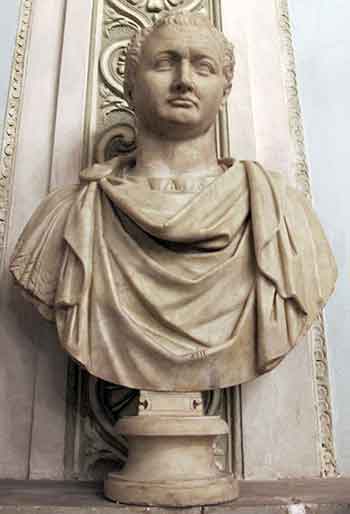
At South Cadbury in Somerset, bodies, weapons and evidence of destruction by fire, my have been some of the victims of Paullinus' revenge. Other sites around the country also have evidence of similar happenings. The historian Suetonius records that many statues, busts and writings were erected in Britain in honour of Titus, Vespasian's eldest son. He may have been instrumental in the destruction of Boudicca and we know he served as a legionary tribune at the time of the rebellion. He was very young at this time, probably about 22 years of age, and it is unusual for one so young to make such an impression.
The new Procurator, Julius Classicanus, ran Britain in the absense of Suetonius who was in Rome being given his Triumph. The new governor, was ex-Consul, Publius Turpilianus, sent by Nero to report directly to him about the condition of post-rebellion Britain. In this report he criticised Suetonius for not ending the war sooner.
Soldiers were transferred in from Germania, to replace the thousands of soldiers lost during the uprising. The Iceni were persecuted. Most were turned into slaves. Temporary forts and lookouts were built in the area of the tribe's lands to keep a close watch in case they decided to rise up again, and as a warning to the rest of the country about the fate of those who rebelled against the Romans.
Actons in the Aftermath
The Romans laid waste to the Iceni farms, even going so far as to build drainage systems to pull all the water from the soil. They desecrated sanctuaries, stole family heirlooms, money, and deprived the people of weapons. Can they be blaimed? It was a bad deal all around, but the Romans won.
Poenius Postumus, the commander of the legion that failed to meet Suetonius in the Midlands, fell on his own sword for his failure and for denying his troops the glory of battle.
Tacitus:
Excellent officer though [Suetonius] was, it was feared that he would abuse their surrender
and punish every offense with undue severity, as if it were a personal injury.
The Romans are rewarded
 Legios II and IX joined Paullinus in the field. Legio XIV was awarded
the honorific title "Martia Victrix", along with a reputation for pride and
invincibility. Legio XX, up till now did not have an honorific title attached to them, were
now subsequently won the right to be called "Valeria Victrix".
Legios II and IX joined Paullinus in the field. Legio XIV was awarded
the honorific title "Martia Victrix", along with a reputation for pride and
invincibility. Legio XX, up till now did not have an honorific title attached to them, were
now subsequently won the right to be called "Valeria Victrix".
Reinforcements arrived from Germany — about 2,000 infantrymen and Legio IX Hispana was brought back up to strength: 8 cohorts of auxiliary troops and 1,000 auxiliary cavalry. The legionnaires went into active duty, while the auxiliaries were placed in winter quarters ready for action if needed.
History records that Titus, son of the emperor Vespasian, was made the prefect of his father's Praetorian Guard and afterwards gained a reputation for showing no quarter to dissidents. Titus went on to become an Emperor in 79AD.
Romans incite the Iceni | The Iceni reach Colchester
London falls | Verulamium is taken
The final battle | Events after the rebellion